

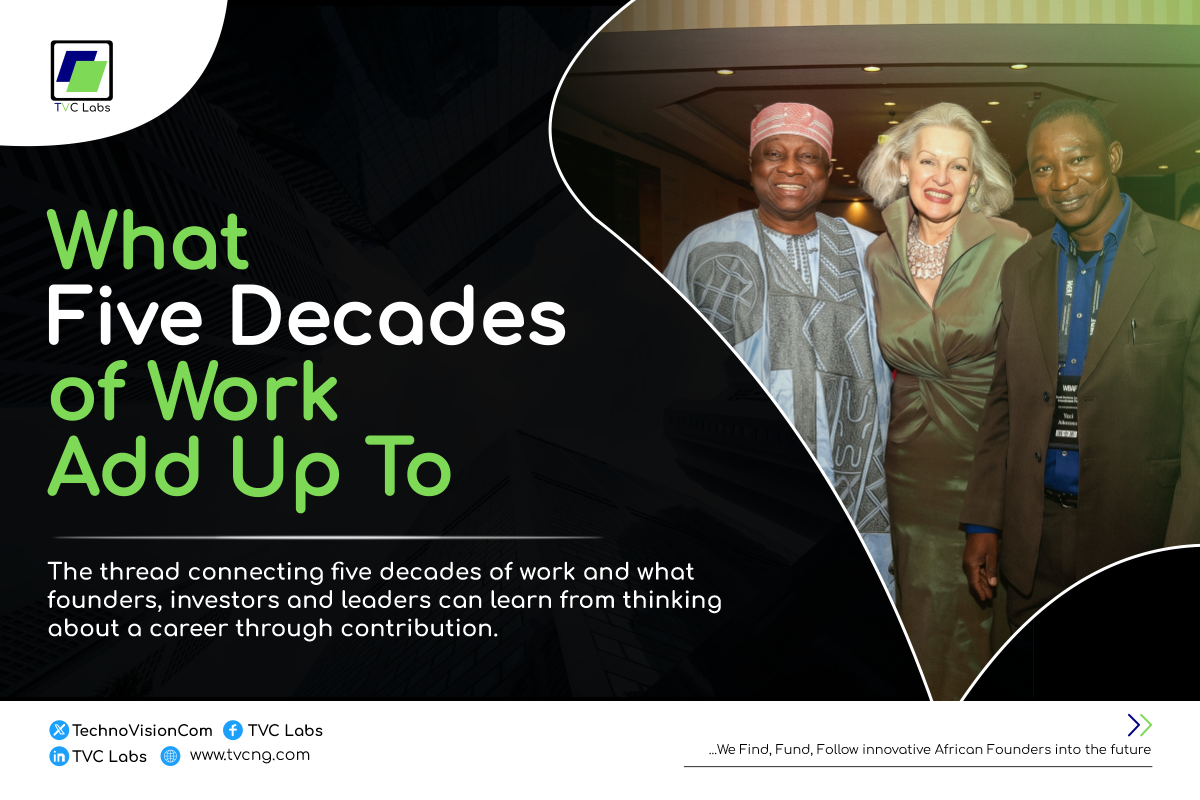
There is a useful way to look at a career that has very little to do with job titles.
Ask what remains after the work is done.
Tomi Davies’ career has now touched five different decades, beginning in technology and digital transformation in the 1980s, moving through global corporations, consulting, project delivery, entrepreneurship, angel investing and, eventually, the work of building infrastructure around African founders and their investors.
The industries changed. The countries changed. The job descriptions certainly changed.
The contribution kept compounding.
A career can become infrastructure
Early in his career, TD worked on technology-enabled transformation for organisations including Elf Aquitaine, Marks & Spencer, Ernst & Young and Sapient, across several parts of the world. By 2000, much of that attention had shifted toward Africa and the question of how technology could be applied to problems closer to home.
Then came startups.
In 2001, he backed Strika Entertainment, the company behind Supa Strikas. He has said he did not even think of himself as an angel investor at the time. He was helping people he knew build something. That first investment would eventually return about 20x.
That detail matters.
Careers rarely announce their most important chapters when they begin.
A useful introduction becomes an investment. An investment becomes experience. Experience becomes pattern recognition. Pattern recognition becomes a philosophy. Eventually, the philosophy becomes something other people can use.
For TD, that progression helped lead to the Lagos Angel Network in 2012, the African Business Angel Network in 2014, decades of founder mentoring and investing, and eventually the POEM Framework® for understanding and evaluating startups.
That is contribution compounding.
Founders should think this way too
Startup culture encourages founders to think in milestones.
Launch.
Revenue.
Funding.
Series A.
Exit.
Milestones matter. But a company becomes more interesting when we also ask what it is contributing while moving between them.
- What capability is being created?
- What problem has become easier because this company exists?
- What knowledge is the team accumulating?
- Who is becoming better because they worked there?
- What infrastructure will remain even if the original product eventually changes?
These questions sound philosophical until you look at the companies that endure.
The strongest businesses accumulate more than revenue. They accumulate capability.
Investors are building something too
The same principle applies to capital.
An angel can make an investment, wait for the outcome and call that a portfolio or an angel can contribute judgement, introductions, operating knowledge and pattern recognition while helping another generation of founders become better allocators of capital themselves.
That second model is harder to measure.
It is also much closer to the mentor-led investing philosophy at TVCLabs.
TVCLabs works with founders from product and customer development through investment readiness and angel funding, while its angel community contributes mentoring, advice, connections and access alongside capital. Its stated ambition is to become the most trusted investment resource for 1,000 startup founders by 2030.
The cheque is an event, the contribution is everything surrounding it.
Leaders should ask a different career question
Most career advice asks:
What do you want to become?
Perhaps a better question is:
What do you want your work to make possible?
Look at the arc of TD’s work and the distinction becomes useful.
- Corporate technology work produced expertise.
- Expertise moved into African technology projects.
- Projects produced experience with founders.
- Founder experience moved into angel investing.
- Angel investing became networks.
- Networks required common language and better ways of evaluating companies.
That work produced POEM: Proposition, Organisation, Economics and Milestones, a framework now used at TVCLabs to create a common language between founders, investors and those supporting them.
The output of one chapter became an input into the next.
That may be one of the more useful ways to think about a long career.
“Do work that leaves you with something worth carrying forward.”
Now, the next problem is becoming clearer
African founders still face a familiar problem when they approach capital.
There is often a gap between the company the founder describes and the company an investor can verify.
Revenue may exist. Customers may exist. Ambition certainly exists.
But investment increasingly runs on evidence.
- Where are the numbers?
- Where are the contracts?
- What has actually happened against the milestones?
- What does the economics of the business look like?
- Can an investor move from interest to diligence without spending weeks reconstructing the company from scattered documents?
TVCLabs’ current MentorPitch process makes that direction explicit: founders seeking structured angel investment are expected to complete Digital Data Room verification before becoming eligible for selection.
This is why we believe the Digital Data Room is the next frontier in founder funding.
It moves the conversation from “trust what I am telling you” to “here is the evidence.”
Perhaps this is an appropriate continuation of the same thread running through five decades of work.
- Make the abstract concrete.
- Turn experience into systems.
- Turn systems into something others can use.
- And leave the next person with a better starting point than the one you had.
If you are building a company and preparing for capital, start there.
Create your Digital Data Room and begin putting the business you are building into numbers.
https://diaglocal.typeform.com/to/Vy2jw1Fg
Share this article with a friend if you found it impactful.